




In the midst of a volatile global economic landscape, businesses stand at a strategic crossroads: balancing the urgent need to maintain resilience against external shocks with the pressure to innovate to avoid falling behind in the AI race.
This article delves into this strategic tension, analyzes the AI trend report 2026, examines current AI implementation realities, and outlines a roadmap for organizations to become an AI-fueled organization.
AI trend report 2026: The strongest IT spending wave in three decades
Not since 1996 has the world witnessed such a massive wave of Information Technology (IT) spending. This boom is not merely the result of routine digitalization; it represents global preparation for AI infrastructure at scale.
According to the AI trend report 2026, by 2027, AI infrastructure spending will account for 14.9% of the overall $5 trillion IT market. Looking back, we have navigated multiple eras: from the New Economy in the late ’90s, the Dot-com crash, the rise of data analytics, the Cloud and Mobile explosion, to post-COVID-19 recovery.
Today, we stand at the peak of the “AI infrastructure wave,” where technology transitions from a supporting tool to the backbone of all business operations.
Executive strategic dilemma: Stability or breakthrough?
CEOs currently face a harsh reality. On one hand, they must buffer against operational stability threats, including inflation, tariffs, supply chain disruptions, tightening regulations, geopolitical conflicts, skill shortages, and recession risks. According to the AI trend report 2026, 56% of business leaders view geopolitical shifts as a top technology-related threat.
On the other hand, nearly all CEOs believe AI offers a window to completely restructure their business models over the next 3–5 years. This creates a core strategic dilemma: How to safeguard the enterprise from risks while simultaneously making bold investments in new operating models, partner ecosystems, and customer engagement channels?
2026 Budget strategy: Prioritizing stability to build momentum
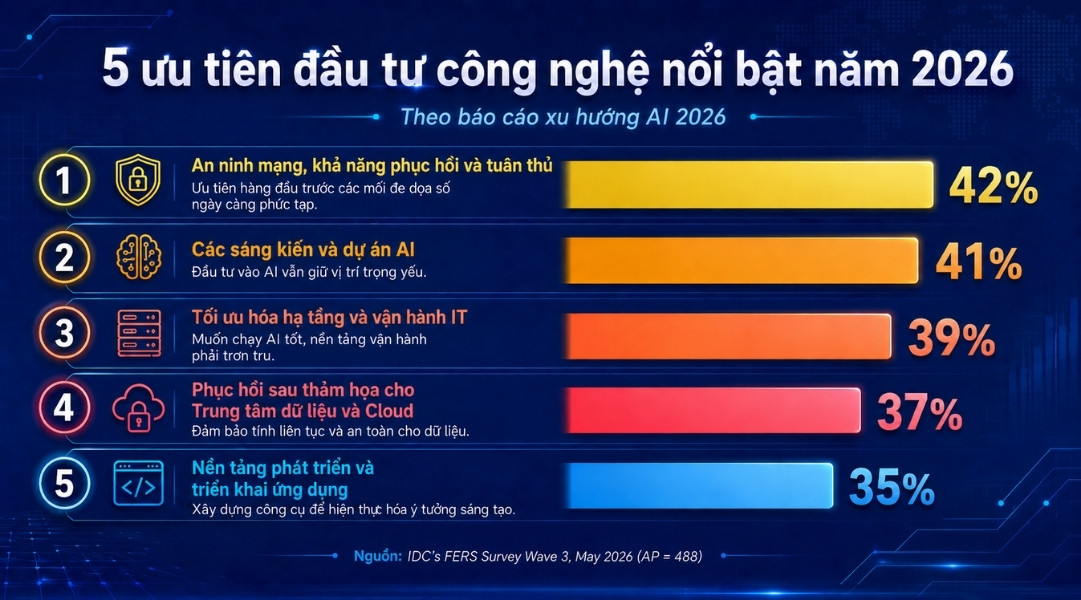
Survey data on 2026 budget priorities reveals a clear pivot toward risk management and operational stability to pave the way for large-scale AI deployment:
- Cybersecurity, resilience, and compliance (42%): The top priority as digital threats grow increasingly complex.
- AI initiatives and projects (41%): AI investments remain a close second right behind cybersecurity.
- IT infrastructure and operations optimization (39%): Core systems must run smoothly to support AI workloads.
- Disaster recovery for data centers and Cloud (37%): Ensuring continuous data availability.
- App development and deployment platforms (35%): Building the toolsets to bring innovative ideas to life.
The AI paradox: High expectations, low realized impact
Despite high expectations, practical AI implementation faces significant hurdles. Only 11% of organizations report achieving measurable business outcomes from their AI initiatives. The majority remain trapped in a cycle of technical and operational friction.
Primary obstacles scaling AI
To successfully scale AI, organizations must solve four major challenges:
- Data readiness (57%): Poor data quality, isolated silos, lack of metadata, and fragmented data flows represent the biggest barrier.
- Infrastructure (55%): A shortage of hybrid/multicloud systems optimized for AI, combined with performance bottlenecks under heavy workloads.
- Governance and ROI (54%): Constantly evolving regulations, lack of centralized AI KPIs, and cost opacity make demonstrating value difficult.
- Talent and execution (50%): Development team skill gaps, misalignment between partners and enterprises, and difficulty maintaining momentum post-deployment.
Technical debt and workflows
According to the AI trend report 2026, many current modernization efforts are only partially successful, leaving behind significant technical debt. Furthermore, organizations are overwhelmed trying to integrate new technologies and reimagine end-to-end workflows. In the Asia-Pacific region, AI and digital projects experience an average delay of around 9 months.
Roadmap to an AI-fueled organization
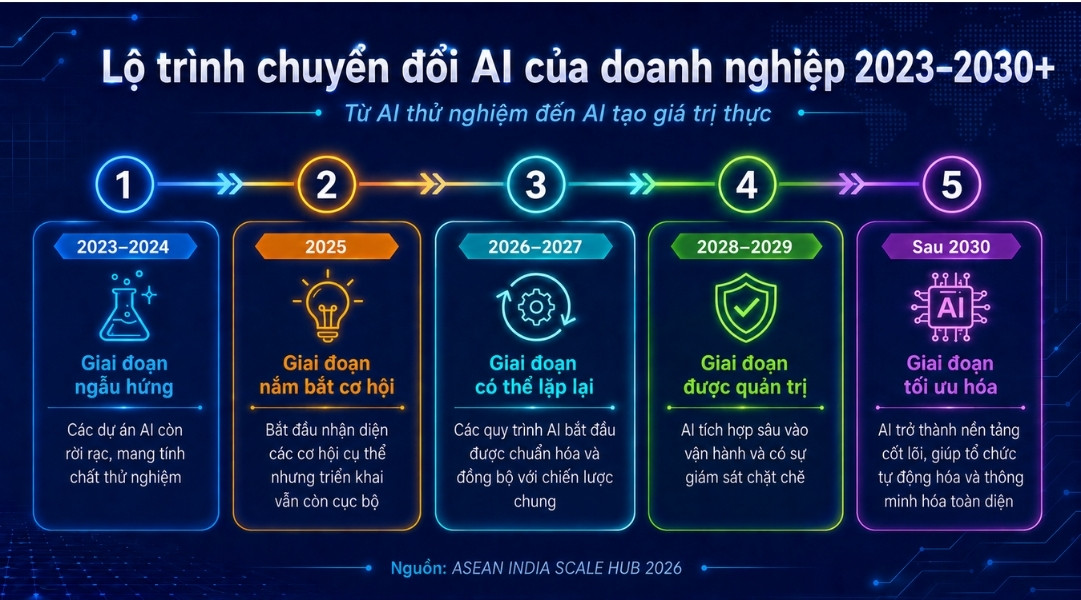
To transition beyond the experimental phase, enterprises must identify their position across a 5-stage maturity model:
- Ad-hoc stage (2023–2024): Fragmented, experimental AI projects.
- Opportunistic stage (2025): Identifying specific opportunities, though deployment remains localized.
- Repeatable stage (2026–2027): AI processes begin to standardize and align with overall strategy.
- Managed stage (2028–2029): Deep AI integration into operations under tight governance.
- Optimized stage (Post-2030): AI serves as the core foundation, enabling comprehensive automation and intelligence.
In the Asia-Pacific region, most organizations (58.2%) remain in the Opportunistic stage, with only 0.2% reaching the Optimized level. This highlights enormous growth potential if businesses address talent, technology, and governance bottlenecks.
Evolving partner ecosystems in the new tech era
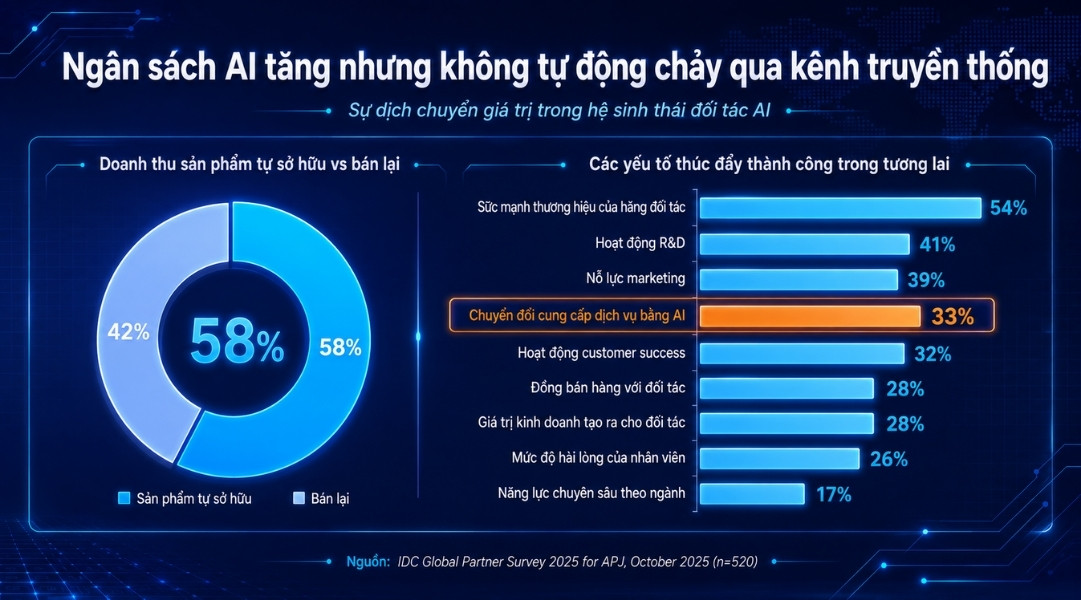
In the AI era, the relationship between enterprises and technology partners is undergoing a fundamental shift. Value is redistributing from traditional services toward specialized AI and data services.
An increased AI budget does not automatically mean revenue will flow through traditional distribution and reseller channels. Surveys indicate that roughly 58% of tech partner revenues now stem from proprietary products and services. Key factors driving future success include:
- Tech partner brand strength (54%)
- R&D capabilities (41%)
- Marketing (39%)
- Capability to deliver AI-driven transformation services (33%)
This trend signals that tech vendors must evolve from mere resellers and implementers into creators of proprietary products, specialized AI services, and solutions tied directly to customer business outcomes.
The future of the digital economy and key execution levers
We are entering a new hyper-growth cycle where “AI agents” take center stage. By 2029, an estimated 1.2 billion AI agents will be active, executing hundreds of billions of actions daily.
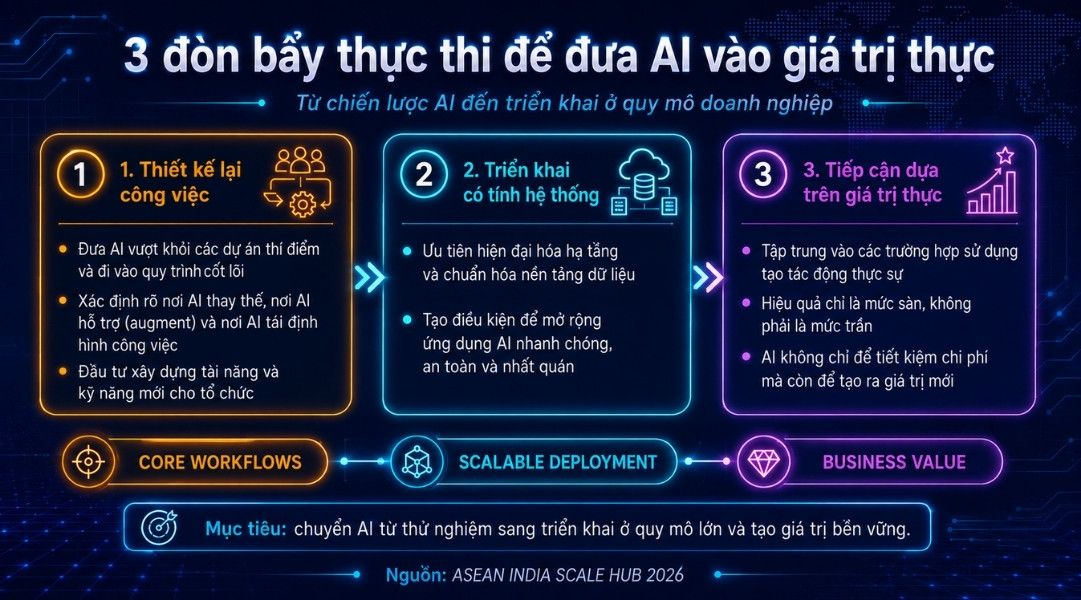
To capture this opportunity, enterprises should focus on three critical execution levers:
- Redesigning work: Go beyond pilot projects by embedding AI into core operations. Clearly define where AI replaces, where AI augments, and where AI fundamentally transforms roles-supported by continuous upskilling.
- Systematic deployment: Prioritize infrastructure modernization and data platform standardization to scale AI applications rapidly and securely.
- Value-driven approach: Target high-impact use cases. Remember: “Efficiency is the floor, not the ceiling.” AI should not merely cut costs-it should unlock entirely new value.
The AI era leaves no room for standing still. The tension between maintaining resilience and driving innovation is a natural part of the transition. By focusing on data readiness, modernizing infrastructure, and decisively redesigning workflows, businesses can successfully navigate the “AI pivot” to lead the future digital economy.
